Комментарий к Блейку/Песни невинности/Сон
| ← Дитя-радость | Комментарий к Блейку/Песни невинности/Сон |
О скорби ближнего → |
| Источник: частные архивы |

William Blake: |
Однажды, сон сплёл полог |
18. Сон / A Dream. Кейнс замечает: «В этом стихотворении Блейк сочинил простой сюжет, который можно, пожалуй, понять как рассказ о затруднительном положении человека, выраженном через образы низших существ. Рассказчик, сам в безопасности и, „охраняемый ангелом“, видит во сне муравьиху, заблудившуюся в траве и беспокоящуюся о своих детях. Рассказчик готов оплакать судьбу насекомого, когда „часовой ночи“ появляется в образе светляка, и объясняет, как с помощью жука добраться до дома. Так человеческий дух, блуждающий в „лесах ночи“ выражается через аллегорию горестей выпадающих на долю самых незначительных из Божьих тварей». Кейнс здесь цитирует вторую строчку из блейковского «Тигра»: «in the forests of the night» — «в лесах ночи». Кейнс заканчивает своё описание так: «Но даже муравьиха не оставлена в беде и приводится к спасению с помощью света светляка, смиренного посланца Божественного сострадания. Простое оформление включает — „часового ночи“ в нижнем правом углу.»
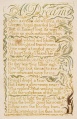
Блейк придал светляку образ стоящего под деревом человека, похожего на пастыря -- с посохом в правой руке, а в левой держащего фонарь. Приглядевшись к рисунку пристальней, мы можем различить среди богатого растительного орнамента маленькие фигурки двух летящих жуков (справа после строчек 4 и 17), нечто вроде ползущего муравья (под словом her в строке 8) и другого подобного насекомого (после слова way третье строки), а в заголовке ясно видны три человеческие фигуры: лежащая (в букве "A"), сидящая и читающая (в букве "D"), и летящая с расставленными в обе стороны руками (под буквой "e"), а также птицу, похожую на парящего орла. (внизу между буквами "A" и "D".
Блейк называет муравья архаическим словом Emmet[2]. То что это муравьиная матка[3] ясно благодаря слову “her” в восьмой строке, но в большинстве русских переводов она превращена в мужскую особь «муравья». вероятно, ради благозвучия. В качестве редкого исключения из этого правила стоит процитировать перевод А. Строкиной, где всё названо своими именами:
Я лежу в траве густой. |
- Комментарий А. Глебовской / С. Степанова (?)
Сон. Снова в полную силу звучит тема божественной защиты, распространяющейся на всех и каждого: Ангел охраняет сон спящего. Муравей думает о своих детях, оставленных без защиты. Жук и Светлячок берут под свою опеку и защиту заблудившегося Муравья. В системе символов «Песен Невинности» все эти хранители являются образами одного Защитника — Бога. Интересно, что в ранних редакциях «Песен» Блейк перенёс это стихотворение в «Песни Опыта» — возможно, основанием для этого послужило то, что в нем воспевается божественность природы, реальной жизни, рисуется картина мира, не соотнесённого с Вечностью. Однако, по всей видимости, впоследствии Блейк счёл идею божественной защиты более важной и вернул «Сон» в первый цикл.
Другие переводы
|
|
|
Ангелок ко мне слетел, |
1975/2009, Москва/Сент-Олбанс, опубл. 2010
Ангелок ко мне слетел, |
1975/2014, Москва/Сент-Олбанс
Об изображении / On the design
- Songs of Innocence, copy U, object 19 (Bentley 26, Erdman 26, Keynes 26)
- Sector E
interlinear Illustration:
Several varieties of vegetation fill spaces around the text and between stanzas. The initial "A" in the title sprouts a plant-like structure on the left, while a loopy vine-like extension dangles all the way down the left margin. The vegetation in the upper right margin—beside the "m" of "Dream" in the title—seems to be an arc of tasseled grass or grain that curves back over the title. Beneath it—opposite stanzas 1 and 2—are three or four clusters of flame-like leaves or tufts of grass. Below those are a bit of leafy vine (after line 10) and a branch or root of some sort (after line 13). In the lower right margin—opposite stanzas 4 and 5—is an odd tree(?). In front of the tree stands a figure, robed, apparently wearing a hat, and holding a staff—probably the "watchman of the night" (line 17), the glow-worm of the text in human form. He is one of four small human figures on the plate. The other three are in the area of the title: lying, presumably sleeping, on the left stroke of the initial "A"; sitting, perhaps reading, in the "D" of "Dream"; and floating or flying, with arms raised horizontally, between bits of vegetation beneath the "e" of "Dream." The animal life of the poem appears in similarly tiny forms in the margins: there could be an ant (the "Emmet" of line 4) beneath the "her" in line 9, another ant or beetle to the right of line 4, and beetles(?) (lines 19-20) flying right of lines 5 and 18. A bird, perhaps an eagle, unmentioned in the text, spreads its wings above "dream" in line 2.
- Component (Sector D)
Keywords: male, watchman, gown, robe, standing, holding
In front of the tree in the bottom right corner stands a figure, robed, wearing a hat, and holding a staff in his(?) right hand, a lantern(?) in his left—probably the "watchman of the night" (line 17), the glow-worm of the text in human form.
- Component (Sector AB)
Keywords: lying, sleeping, sitting, facing left, facing right, reading, hovering, flying, arms raised horizontally
There are three tiny figures in the area of the title: one lying, presumably sleeping, on the left stroke of the initial "A"; a second sitting, facing left, probably reading, in the "D" of "Dream"; and a third hovering or flying with arms raised horizontally between bits of vegetation beneath the "e" of "Dream."
- Component (Sector BD)
Keywords: insect, ant, emmet, beetle, caterpillar, worm, flying, wing, anthropomorphic, glow-worm
The insect life of the poem appears in tiny forms in the margins: there could be an ant (the "Emmet" of line 4) beneath the "her" in line 9, another ant or beetle crawling to the right of line 4, a worm or caterpillar nestled in the lower right sprigs of the vegetation right of line 6, and perhaps winged beetles (lines 19-20) flying right of lines 5 and 18. The human figure lower right may be the anthropomorphic form of the "glow-worm" (line 15).
- Component (Sector A)
Keywords: bird, eagle, flying
A bird, perhaps an eagle, soars just below the space between "A" and "Dream" in the title.
- Component (Sector E)
Keywords: vine, loop, leaf, tree, grain tassel, grain stem, branch, root, grass
Several varieties of vegetation fill spaces around the text and between stanzas. The initial "A" in the title sprouts a plant-like structure on the left, while a loopy vine-like extension dangles all the way down the left margin. A further extension of this vine, or an independent vine, runs horizontally below the last stanza. The vegetation in the upper right margin—beside the "m" of "Dream" in the title—seems to be an arc of tasseled grass or grain that curves back over the title. Beneath it—opposite stanzas 1 and 2—are three or four clusters of flame-like leaves or tufts of grass. Below those are a bit of leafy vine (after line 10) and a branch or root of some sort (after line 13). In the lower right margin—opposite stanzas 4 and 5—is an odd tree(?).
- Component (Sector D)
Keywords: hat, staff, lamp
The watchman in the lower right corner may be holding a staff in his right hand and a second object—perhaps a lantern—in his left. He seems to be wearing a hat.
Примечания
- ↑ Авторское написание. — The author's spelling (according to David V. Erdman's "Complete Poetry & Prose of William Blake" edition).
- ↑ Emmet. English Etymology: Middle English emete, from Old English æmete, (bef. 12c) Cognate to ant. Pronunciation IPA(key): /ˈɛmɪt/ Rhymes: -ɛmɪt. Noun emmet (plural emmets) 1.(archaic) An ant — ants are often red in colour and appear to mill around. 2.(Cornish, pejorative) A tourist
- ↑ Муравьиная матка, или царица — яйцекладущая самка муравьёв. Муравьиная семья содержит одну (моногиния) репродуктивную самку или несколько откладывающих яйца самок (полигиния), в зависимости от видовой принадлежности и размера семьи. <...> После «брачного полёта» и оплодотворения они сами себе обламывают крылья, чтобы основать новую семью или остаться в материнской колонии. К крупнейшим муравьям на Земле относят маток (королев) рода кочевников Dorylus, которые в оседлую фазу в момент созревания яиц имеют сильно увеличенное брюшко и общую длину до 5 см (Dorylus wilverthi).
Галерея / Gallery
-
 Songs of Innocence copy G 1789 Yale Center for British Art object 4
 -
 Songs of Innocence, copy U, 1789 (The Houghton Library) object 19-26 A Dream.jpg 625 KB
 -
 Songs of Innocence and of Experience, copy AA, 1826 (The Fitzwilliam Museum) object 26 Dream.jpg 525 KB
 -
 Songs of Innocence and of Experience, copy F, 1789, 1794 (Yale Center for British Art) obgect 15-26 A Dream.jpg 63 KB
 -
 Songs of Innocence and of Experience, copy L, 1795 (Yale Center for British Art) 15-26 A Dream.jpg 641 KB
 -
 Blake A Dream - Copy W 44 KB
 -
 Songs of Innocence and of Experience, copy Y, 1825 (Metropolitan Museum of Art) object 26 A DREAM
 -
 Songs of Innocence and of Experience, copy Z, 1826 (Library of Congress) object 26 A Dream.jpg 822 KB
 -
Songs of Innocence and of Experience, copy AA, 1826 (The Fitzwilliam Museum) object 26 A DREAM
_object_19-26_A_Dream.jpg)
_object_26_Dream.jpg)
_obgect_15-26_A_Dream.jpg)
_15-26_A_Dream.jpg)

_object_26_DREAM.jpg)
_object_26_A_Dream.jpg)
См. также
- Songs of Innocence by William Blake, 1789 / Песни невинности Уильяма Блейка, 1789
- Сон (С. Маршак)
- Сон (Д. Смирнов-Садовский)
- Комментарий к Блейку/Песни невинности/Сон
- Commons:Category:Songs of Innocence - A Dream

|
Данное произведение является собственностью своего правообладателя и представлено здесь исключительно в ознакомительных целях. Если правообладатель не согласен с публикацией, она будет удалена по первому требованию. / This work belongs to its legal owner and presented here for informational purposes only. If the owner does not agree with the publication, it will be removed upon request. |